
| Opening Up to Open Triads By Jean-Marc Belkadi/ January 2004. Just about every guitar player in the world knows how to play the simple, three-note C chord in Ex. 1. But far fewer guitarists realize that because this triad’s root, 3, and 5 (C, E, and G, respectively) all reside within the same octave, it’s a perfect example of close harmony. Why is this little fact even worth knowing? Because, if you understand close harmony, then you’re one step closer to understanding open harmony, the use of which will allow you to create some uniquely tantalizing chords, riffs, and textures. Open up and get a little closer ... Full article click here |
Blue Moves, by Jean-Marc Belkadi. / July 2003
There's something magical about blues turnarounds. They mark—with
great satisfaction —the harmonic climax of the 12-bar cycle, whether they’
re opening or closing a tune. So why do most guitarists only bother to
learn a small handful of them? Truth is, you can crack open a treasure
chest of hip turnarounds by simply spending a few moments
experimenting with the ones you already know. And here's three you
definitely want to know.
Full article click here
There's something magical about blues turnarounds. They mark—with
great satisfaction —the harmonic climax of the 12-bar cycle, whether they’
re opening or closing a tune. So why do most guitarists only bother to
learn a small handful of them? Truth is, you can crack open a treasure
chest of hip turnarounds by simply spending a few moments
experimenting with the ones you already know. And here's three you
definitely want to know.
Full article click here
| Guitar Player Magazine Chopsbuilder Column featuring: Fourths, Fifths, Flash by Jean-Marc Belkadi / October 2002 Issue. Perfect Fourths are easy to find on the guitar. Just strum the open strings in standard... Full article click here |
Guitar Player Magazine, Session Column featuring:
Composite Blues by Jean-Marc Belkadi /January 2001 Issue.The next
time you're looking for a way to juice up your blues lines, try this...
Full article click here
Composite Blues by Jean-Marc Belkadi /January 2001 Issue.The next
time you're looking for a way to juice up your blues lines, try this...
Full article click here
| Guitar Player Magazine, Session Column featuring: Old Dog, New Tricks by Jean-Marc Belkadi / September 2000 Issue. Scales are the building blocks of nearly all melodic improvised lines... Full article click here |
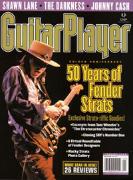
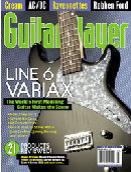
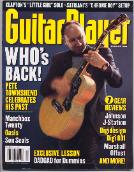
| Chordal Kung Fu By Jean-Marc Belkadi, Jude Gold | Guitar Player Magazine January 2006 Sharing musical examples inspired by Wes Montgomery, Joe Pass, George Benson, Pat Metheny, Kevin Eubanks, Grant Green, and several other jazz legends, Belkadi hopes this Master Class will help GP readers gain insight into the under-documented art of soloing in two-, three-, and even four-part harmony. “What is the logic behind these techniques?” Belkadi asks rhetorically. “Is there a system I can learn? How does it work? Which chords can I use and why? What is the mentality being employed? Can I use my comping skills within my solos? These are questions my students ask me all the time, and the answers are often simpler than they expect. Full article here |
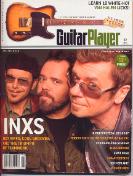
| Fatten Up Your Lead Licks by Learning the Lost Art of Soloing With Chords |
Bustin Out! By Jean-Marc Belkadi | February 2005
The Top 12 Coolest Ways to Play Outside Licks on Guitar
As a guitar instructor at GIT in Hollywood, California, I’m thrilled to report an exciting trend: Young
guitar students are increasingly into playing again. That’s not to imply there weren’t still throngs of
kids hungry to learn adventurous guitar styles during the height of the grunge, nü-metal, and pop-
punk eras—three arguably uninventive, creativity-stifling periods in guitar’s recent history. It’s just
that lately, well, lead guitar seems to be experiencing a resurgence, as it has once again captured
the imaginations of up-and-coming guitarists everywhere. Full article click here
The Top 12 Coolest Ways to Play Outside Licks on Guitar
As a guitar instructor at GIT in Hollywood, California, I’m thrilled to report an exciting trend: Young
guitar students are increasingly into playing again. That’s not to imply there weren’t still throngs of
kids hungry to learn adventurous guitar styles during the height of the grunge, nü-metal, and pop-
punk eras—three arguably uninventive, creativity-stifling periods in guitar’s recent history. It’s just
that lately, well, lead guitar seems to be experiencing a resurgence, as it has once again captured
the imaginations of up-and-coming guitarists everywhere. Full article click here
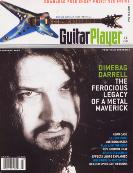
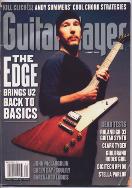
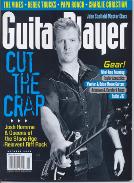
Spank!
By Jude Gold | December 2006
Reference: Guitar Slap and PopTechnique Book by Jean Marc Belkadi
Okay, guitarslingers, enough’s enough. For decades, funk bassists have been having heaps of fun
with this whole “slap/pop” thing, and we guitarists—a typically me-oriented bunch not known for being
generous with the spotlight—have, for some inexplicable reason, politely let our four-stringed
brethren have this flashy style all to themselves. Well, it’s time we finally grabbed a fat slice of the
slap/pop pie—especially because a slapped guitar yields astonishingly cool textures that bassists
simply can’t match (unless they cop our game and bring distortion, octave harmonics, effects, wah
pedals, bent notes, chords, and high strings into the mix). Full article click here
By Jude Gold | December 2006
Reference: Guitar Slap and PopTechnique Book by Jean Marc Belkadi
Okay, guitarslingers, enough’s enough. For decades, funk bassists have been having heaps of fun
with this whole “slap/pop” thing, and we guitarists—a typically me-oriented bunch not known for being
generous with the spotlight—have, for some inexplicable reason, politely let our four-stringed
brethren have this flashy style all to themselves. Well, it’s time we finally grabbed a fat slice of the
slap/pop pie—especially because a slapped guitar yields astonishingly cool textures that bassists
simply can’t match (unless they cop our game and bring distortion, octave harmonics, effects, wah
pedals, bent notes, chords, and high strings into the mix). Full article click here

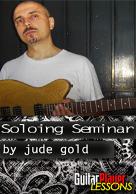
Guitar Player Magazine, January 2008 issue.
"Extreme Sweeping Jean-Marc Belkadi's Polytonal Plectrum Pyrotechnics" by Jude Gold.
The polytonal and bi-tonal licks I’m going to show you are directly inspired by listening to pianists
such as Chick Corea and Herbie Hancock, as well as saxophone players like Michael Brecker and
Joe Henderson,” says Belkadi, one day before embarking on a clinic tour of Europe (which would
include a stop in his native city of Toulouse, France). The examples Belkadi shares can be used
in rock, jazz, fusion, even shred metal, and they all have a cool, modern sound. And, thanks to
sweep technique, they can each be played quite fast. Also, any of the examples can be used as
an exercise to improve sweep timing, because keeping the notes evenly spaced as you rake your
pick across the strings in either direction is one of the trickiest challenges of the style. Full article
click here
"Extreme Sweeping Jean-Marc Belkadi's Polytonal Plectrum Pyrotechnics" by Jude Gold.
The polytonal and bi-tonal licks I’m going to show you are directly inspired by listening to pianists
such as Chick Corea and Herbie Hancock, as well as saxophone players like Michael Brecker and
Joe Henderson,” says Belkadi, one day before embarking on a clinic tour of Europe (which would
include a stop in his native city of Toulouse, France). The examples Belkadi shares can be used
in rock, jazz, fusion, even shred metal, and they all have a cool, modern sound. And, thanks to
sweep technique, they can each be played quite fast. Also, any of the examples can be used as
an exercise to improve sweep timing, because keeping the notes evenly spaced as you rake your
pick across the strings in either direction is one of the trickiest challenges of the style. Full article
click here
Contact Me if you want to schedule a Video Live
Lesson through Skype.
Only Paypal Payment Accepted!
Lesson through Skype.
Only Paypal Payment Accepted!




by MCB

Belkadi
on
on