
Guitar Player Magazine, Session Column featuring:
Old Dog, New Tricks by Jean-Marc Belkadi / September 2000 Issue.
Scales are the building blocks of nearly all melodic improvised lines, yet simply climbing
up and down a favorite scale is a foolproof recipe for creating lines that are as enticing as
leftover scrambled eggs. So how can we make scale-base lines and licks sound personal
and unique? One simple, yet powerful way to give scales a fresh spin is with octave
displacement. Here’s the concept: Simply play the notes of any given scale in ascending
or descending order, but shift a few of the notes up or down an octave from their normal
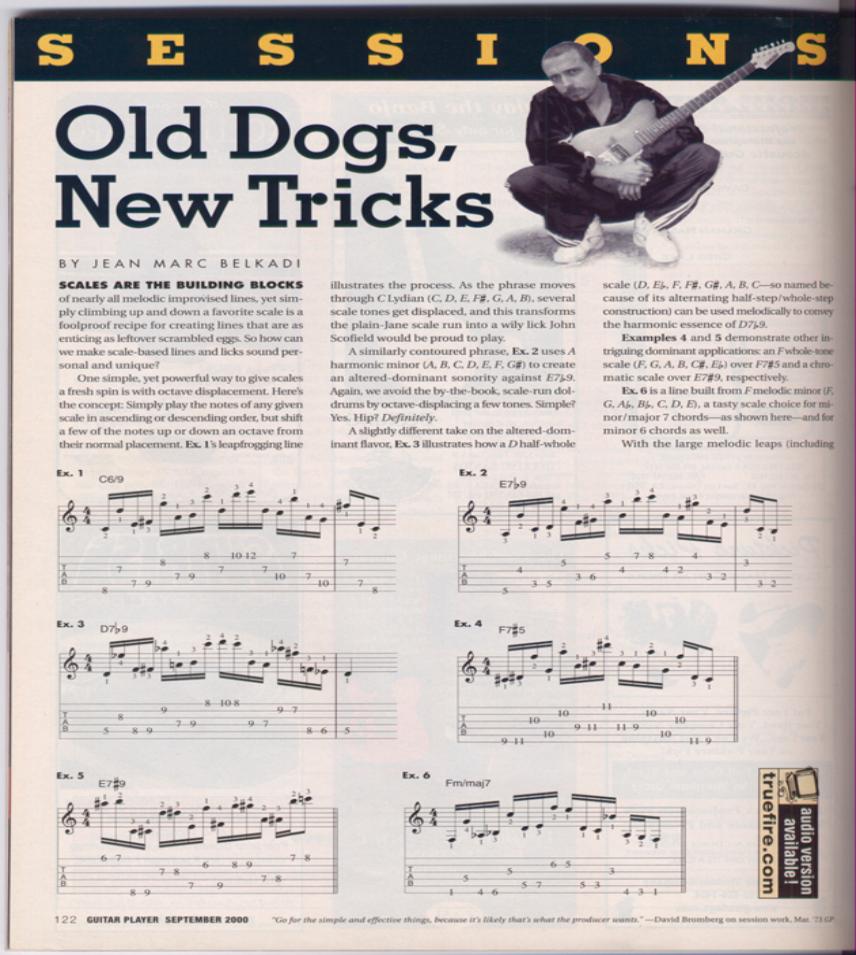
placement. EX. 1’s leapfrogging line illustrates the process. As the phrase moves through
C Lydian (C, D, E, F#, G, A, B) several scale tones get displaced, and this transforms the
plain-Jane scale run into a wily lick John Scofield would be proud to play.
A similar contoured phrase, Ex. 2 uses A harmonic minor (A, B, C, D, E, F, G#) to create an altered-dominant sonority against E7b9.
Again, we avoid the by the book, scale-run doldrums by octave-displacing a few tones. Simple ? Yes. Hip? Definitely.
A slightly different take on the altered-dominant flavor, Ex. 3 illustrates how a D half-whole scale (D, Eb, F, F#, G#, A, B, C-- so named
because of its alternating half-step/whole-step construction) can be used melodically to convey the harmonic essence of D7b9.
Example 4 and 5 demonstrate other intriguing dominant applications: an F whole-tone scale (F, G, A, B, C#, Eb) over F7#5 and a
chromatic scale over E7#9, respectively.
Ex. 6 is a line built from F melodic minor (F, G, Ab, Bb, C, D, E) a tasty scale choice for minor/major 7 chords-as shown here-and for
minor 6 chords as well.
With the large melodic leaps (including ninths and tenth) and tricky string-skipping inherent in octave-displaced phrases, you may find
yourself stumbling here and there. Don’t panic- the concept is easy, but it takes time to master the quirky maneuvers. A few tips for
further exploration:
- Use alternate (down/up) picking and give even weight to each note. You can add accents later, but first strive for uniformity in each
line.
- Record the suggested chords for each example and then play the examples over your prerecorded harmony. This way you’ll
experience each line in its harmonic context. You may find that these lines can also work with other chord types. Trust your ears-if a
line sounds good in a different setting, use it.
Create your own octave-displaced lines. Try a variety of scales and modes and explore different fretboard positions.
Old Dog, New Tricks by Jean-Marc Belkadi / September 2000 Issue.
Scales are the building blocks of nearly all melodic improvised lines, yet simply climbing
up and down a favorite scale is a foolproof recipe for creating lines that are as enticing as
leftover scrambled eggs. So how can we make scale-base lines and licks sound personal
and unique? One simple, yet powerful way to give scales a fresh spin is with octave
displacement. Here’s the concept: Simply play the notes of any given scale in ascending
or descending order, but shift a few of the notes up or down an octave from their normal
placement. EX. 1’s leapfrogging line illustrates the process. As the phrase moves through
C Lydian (C, D, E, F#, G, A, B) several scale tones get displaced, and this transforms the
plain-Jane scale run into a wily lick John Scofield would be proud to play.
A similar contoured phrase, Ex. 2 uses A harmonic minor (A, B, C, D, E, F, G#) to create an altered-dominant sonority against E7b9.
Again, we avoid the by the book, scale-run doldrums by octave-displacing a few tones. Simple ? Yes. Hip? Definitely.
A slightly different take on the altered-dominant flavor, Ex. 3 illustrates how a D half-whole scale (D, Eb, F, F#, G#, A, B, C-- so named
because of its alternating half-step/whole-step construction) can be used melodically to convey the harmonic essence of D7b9.
Example 4 and 5 demonstrate other intriguing dominant applications: an F whole-tone scale (F, G, A, B, C#, Eb) over F7#5 and a
chromatic scale over E7#9, respectively.
Ex. 6 is a line built from F melodic minor (F, G, Ab, Bb, C, D, E) a tasty scale choice for minor/major 7 chords-as shown here-and for
minor 6 chords as well.
With the large melodic leaps (including ninths and tenth) and tricky string-skipping inherent in octave-displaced phrases, you may find
yourself stumbling here and there. Don’t panic- the concept is easy, but it takes time to master the quirky maneuvers. A few tips for
further exploration:
- Use alternate (down/up) picking and give even weight to each note. You can add accents later, but first strive for uniformity in each
line.
- Record the suggested chords for each example and then play the examples over your prerecorded harmony. This way you’ll
experience each line in its harmonic context. You may find that these lines can also work with other chord types. Trust your ears-if a
line sounds good in a different setting, use it.
Create your own octave-displaced lines. Try a variety of scales and modes and explore different fretboard positions.




Belkadi
on
on


Designed by GuitarMerch