
Blue Moves, by Jean-Marc Belkadi.
There’s something magical about blues turnarounds. They mark --
with great satisfaction -- the harmonic climax of the 12-bar cycle, whether
they’re opening or closing a tune. So why do most guitarists only bother to learn
a small handful of them? Truth is, you can crack open a treasure chest of hip
turnarounds by simply spending a few moments experimenting with the ones
you already know.
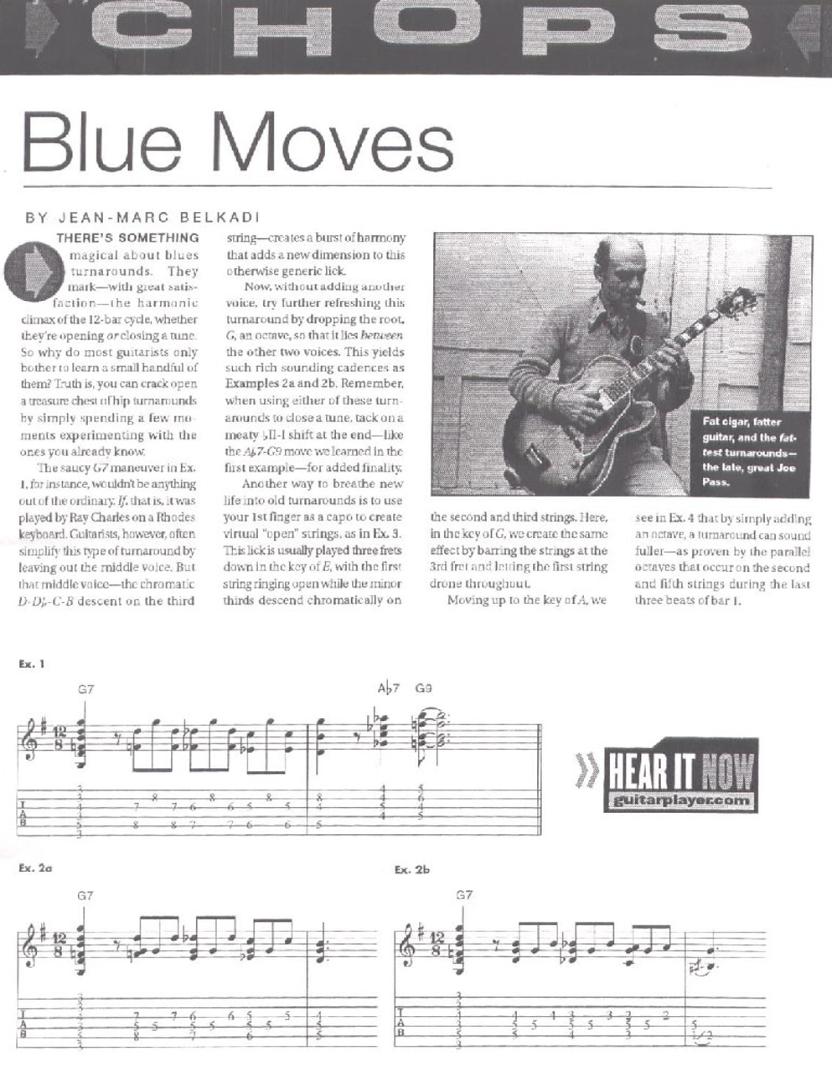
The saucy G7 maneuver in EX.1, for instance, wouldn’t be anything out of the
ordinary. If, that is, it was played by Ray Charles on a Rhodes keyboard.
Guitarists, however, often simplify this type of turnaround by leaving out
the middle voice. But that middle voice -- the chromatic D-Db-C-B descent
on the third string- creates a burst of harmony that adds a new dimension
to this otherwise generic lick.
Now, without adding another voice, try further refreshing this turnaround by dropping the root, G, an octave, so that it lies
between the other 2 voices. This yields such rich sounding cadences as Example 2a and 2b. Remember, when using either of
these turnarounds to close a tune, tack on a meaty bII-I shift at the end- like the Ab7-G9 move we learned in the first example-
for added finality.
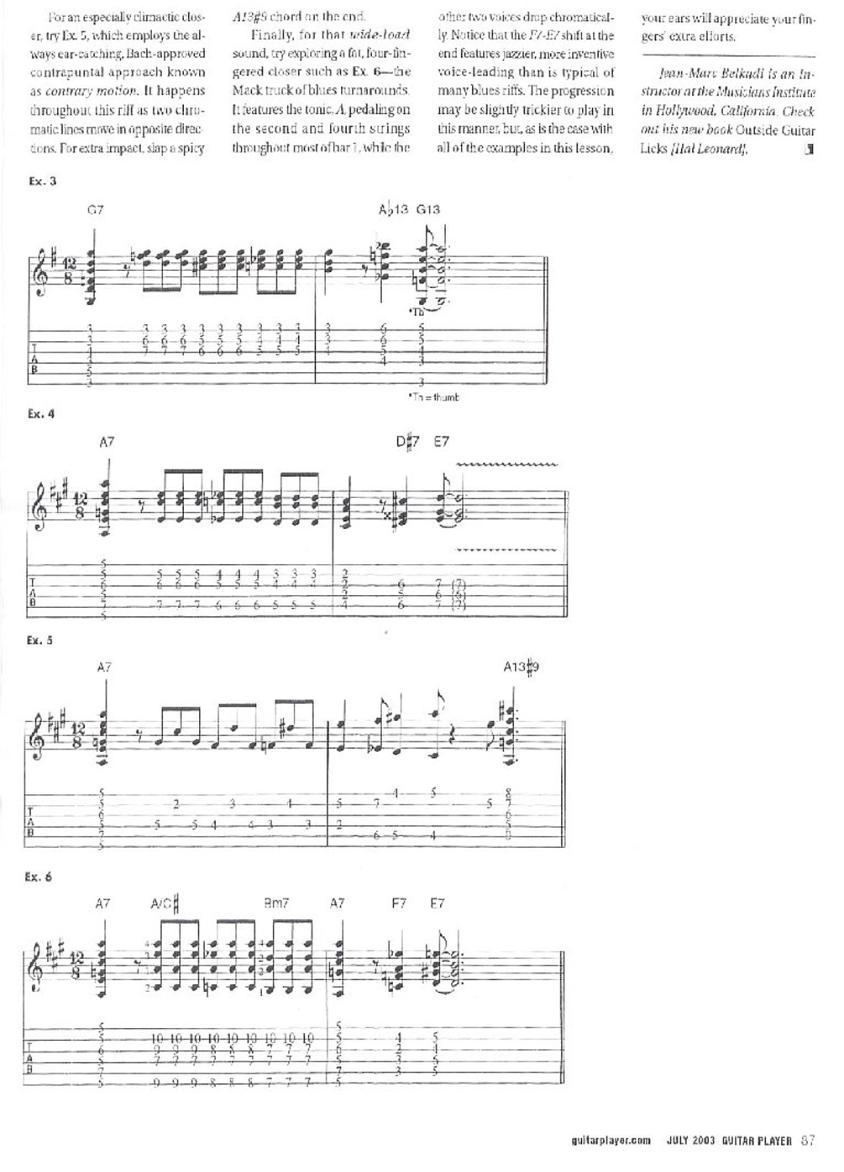
Another way to breathe new life into old turnarounds is to use your 1st finger as a capo to create virtual “open” strings, as in EX.
3. This lick is usually played three frets down in the key of E, with the first string ringing open while the minor thirds descend
chromatically on the second and third strings. Here, in the key of G, we create the same effect by barring the strings at the 3rd
fret and letting the first string drone throughout.
Moving up to the key of A, we see in EX.4 that by simply adding an octave, a turnaround can sound fuller-
as proven by the parallel octaves that occur on the second and fifth strings during the last three beats of bar 1.
For an especially climatic closer, try EX.5 which employs the always ear-catching, Bach-approved contrapuntal approach known
as contrary motion. It happens throughout this riff as two chromatic lines move in opposite directions. For extra impact, slap a
spicy A13#9 chord on the end.
Finally, for that wide-load sound, try exploring a fat, four-fingered closer such as EX.6 -- the Mack truck of blues turnarounds. It
features the tonic, A, pedaling on the second and fourth strings throughout most of bar 1, while the other two voices drop
chromatically. Notice that the F7-E7 shift at the end features jazzier, more inventive voice-leading than is typical of many blues
riffs. The progression may be slightly trickier to play in this manner, but, as is the case with all of the examples in this lesson,
your ears will appreciate your fingers’ extra efforts.
There’s something magical about blues turnarounds. They mark --
with great satisfaction -- the harmonic climax of the 12-bar cycle, whether
they’re opening or closing a tune. So why do most guitarists only bother to learn
a small handful of them? Truth is, you can crack open a treasure chest of hip
turnarounds by simply spending a few moments experimenting with the ones
you already know.
The saucy G7 maneuver in EX.1, for instance, wouldn’t be anything out of the
ordinary. If, that is, it was played by Ray Charles on a Rhodes keyboard.
Guitarists, however, often simplify this type of turnaround by leaving out
the middle voice. But that middle voice -- the chromatic D-Db-C-B descent
on the third string- creates a burst of harmony that adds a new dimension
to this otherwise generic lick.
Now, without adding another voice, try further refreshing this turnaround by dropping the root, G, an octave, so that it lies
between the other 2 voices. This yields such rich sounding cadences as Example 2a and 2b. Remember, when using either of
these turnarounds to close a tune, tack on a meaty bII-I shift at the end- like the Ab7-G9 move we learned in the first example-
for added finality.
Another way to breathe new life into old turnarounds is to use your 1st finger as a capo to create virtual “open” strings, as in EX.
3. This lick is usually played three frets down in the key of E, with the first string ringing open while the minor thirds descend
chromatically on the second and third strings. Here, in the key of G, we create the same effect by barring the strings at the 3rd
fret and letting the first string drone throughout.
Moving up to the key of A, we see in EX.4 that by simply adding an octave, a turnaround can sound fuller-
as proven by the parallel octaves that occur on the second and fifth strings during the last three beats of bar 1.
For an especially climatic closer, try EX.5 which employs the always ear-catching, Bach-approved contrapuntal approach known
as contrary motion. It happens throughout this riff as two chromatic lines move in opposite directions. For extra impact, slap a
spicy A13#9 chord on the end.
Finally, for that wide-load sound, try exploring a fat, four-fingered closer such as EX.6 -- the Mack truck of blues turnarounds. It
features the tonic, A, pedaling on the second and fourth strings throughout most of bar 1, while the other two voices drop
chromatically. Notice that the F7-E7 shift at the end features jazzier, more inventive voice-leading than is typical of many blues
riffs. The progression may be slightly trickier to play in this manner, but, as is the case with all of the examples in this lesson,
your ears will appreciate your fingers’ extra efforts.




Belkadi
on
on


Designed by GuitarMerch